
Can Artificial Intelligence (AI)-Generated Images Function as Magical Tools?
If you’ve seen my blog post about Emoji Spells, you’ll know I have a bit of a thing for technomancy. So when curiosity tugged at the edge of my mind again (this time about imagery as a medium) I gave in, handed the reins to my current fascination with AI, and let ChatGPT take the wheel as a kind of guest blogger. What followed was intriguing.
As ever with my AI adventures, treat this as exploratory research: a blend of curiosity, creative experimentation, and informed speculation. Citations and footnotes are included where relevant. Curiosity deserves credit.
Here are the prompts I used:

AI-Generated Images as Modern Spellwork: Visual Magic in the Digital Occult
Written by ChatGPT, OpenAI’s language model – 7 June 2025, 14:00 BST
Introduction
In the evolving landscape of contemporary witchcraft and occult practices, artificial intelligence (AI) has emerged as a transformative tool. AI-generated images, once the domain of technologists and artists, are now being embraced by modern witches and occultists as instruments of visual magic and spellwork. This report explores the intersection of AI, symbolic intention, and magical visual language, examining whether AI-generated imagery functions as a form of modern spellwork within digital witchcraft and contemporary occult practices.¹ ² ⁵ ⁶

1. Symbolism and Intention in Magical Practices
At the heart of magical practices lies the use of symbols imbued with intention. Symbols serve as vessels for meaning, allowing practitioners to communicate with the unseen and manifest desired outcomes. Susanne Langer, in her exploration of symbolism, emphasised that “the human mind is constantly carrying on a process of symbolic transformation of the experiential data that come to it.”³ This process is central to magical practices, where symbols are not merely representations but active agents in ritual and spellwork.
2. AI and the Generation of Symbolic Imagery
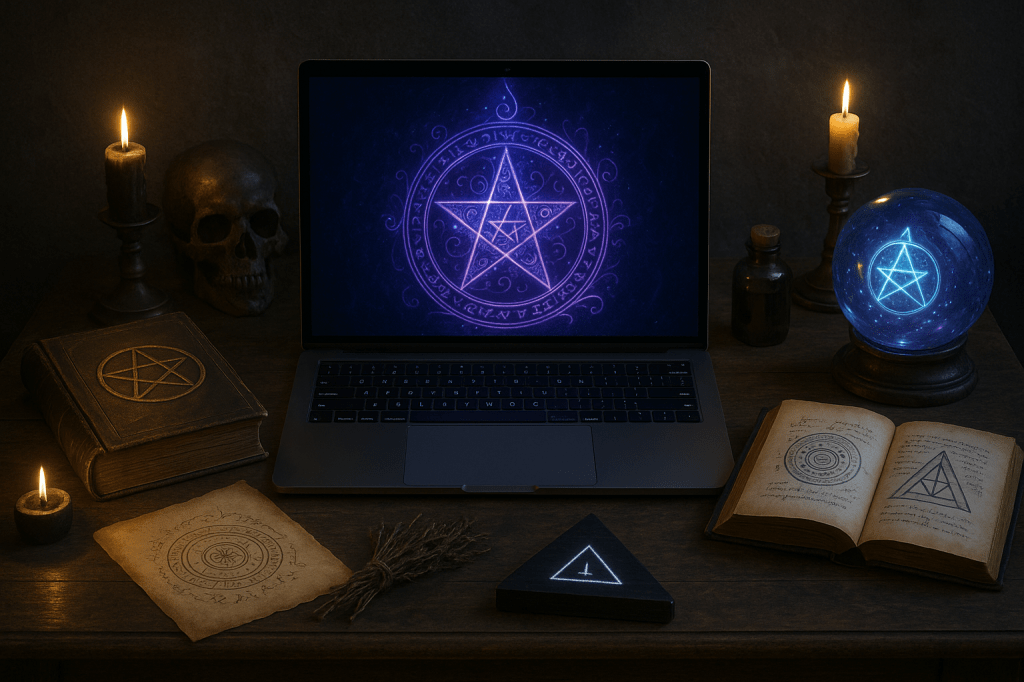
AI technologies, particularly those employing neural networks and generative algorithms, have advanced to the point where they can create complex, evocative images based on textual prompts. These AI-generated images often resonate with the symbolic language of magic, featuring archetypal elements such as pentagrams, mystical landscapes, and esoteric figures. Practitioners have begun using AI tools such as Midjourney, DALL·E, and Runway to generate spellcraft visuals, sigils, and personalised magical aids.⁴ ⁶ ⁷

3. Digital Witchcraft and the Integration of AI
The integration of AI into witchcraft is part of a broader trend of digital spiritual practice. Platforms like TikTok have seen the rise of communities such as #WitchTok, where practitioners share digital spells, rituals, and even AI-generated content.² Digital altars, tarot readings via app, and sigil generators are examples of how technology is shaping and amplifying esoteric traditions online.⁵ ⁶
4. AI-Generated Imagery as Modern Spellwork
The use of AI-generated images in magical practice can be seen as a form of modern spellwork. By inputting specific intentions into AI systems, practitioners can generate visuals that encapsulate their desired outcomes. These function like talismans or sigils in chaos magic, where belief and intention—not the tool itself—carry the power.⁷ This aligns with technopagan and techno-animist beliefs that spiritual intention can interface with digital systems.⁸ ⁹
5. Ethical Considerations and Cultural Implications
While AI offers creative and magical potential, it also raises ethical concerns. Generating magical symbols, deities, or culturally specific artefacts via AI tools can unintentionally lead to appropriation or misrepresentation. Practitioners should critically evaluate the use of AI-generated content to ensure their magical work honours the original cultural and spiritual frameworks from which such symbols may arise.¹⁰ ¹¹
Conclusion
AI-generated images represent a convergence of technology and tradition, offering witches and occultists new tools for visual magic and spellwork. By harnessing AI’s symbolic potential, practitioners can expand their magical repertoire, creating personalised imagery that resonates with their intentions.
As digital witchcraft continues to evolve, the integration of AI stands as a testament to the adaptability and innovation at the heart of esoteric practice.
Note: The images described above are intended to complement the themes discussed in this report. Practitioners are encouraged to create or source imagery that aligns with their personal practice and ethical considerations
References
- Koo, C. (2024). How Blockchain and AI Are Recasting Ancient Occult Practices. Decrypt. https://decrypt.co/230135/how-blockchain-and-ai-are-recasting-ancient-occult-practices
- Miller, C. (2022). How Modern Witches Enchant TikTok: Intersections of Digital, Consumer, and Material Culture(s) on #WitchTok. Religions, 13(2), Article 118. https://doi.org/10.3390/rel13020118
- Langer, S. (1942). Philosophy in a New Key. Harvard University Press. ISBN: 9780674665033. Available via Amazon UK
- Cointribune. (2024). Crypto: AI and Blockchain Modernize Occult Practices. https://www.cointribune.com/en/crypto-ai-and-blockchain-modernize-occult-practices/
- Wikipedia contributors. (2025). Technopaganism. Wikipedia. https://en.wikipedia.org/wiki/Technopaganism
- The Guardian. (2025). In Thailand, where mysticism thrives, AI fortune telling finds fertile ground. https://www.theguardian.com/world/2025/jun/05/in-thailand-where-mysticism-thrives-ai-fortune-telling-finds-fertile-ground
- The Wild Hunt. (2025). Is There a Place for Generative AI in Creating Spells and Rituals? https://wildhunt.org/2025/01/is-there-a-place-for-generative-ai-in-creating-spells-and-rituals.html
- Wikipedia contributors. (2025). Techno-animism. Wikipedia. https://en.wikipedia.org/wiki/Techno-animism
- Wikipedia contributors. (2025). Theta Noir. Wikipedia. https://en.wikipedia.org/wiki/Theta_Noir
- Round the Cauldron. (2025). Witches Against AI. https://roundthecauldron.com/witches-against-ai/
- The Guardian. (2024). It’s possible to find spirituality in technology—but beware those who misuse it for personal gain. https://www.theguardian.com/commentisfree/2024/jan/18/its-possible-to-find-spirituality-in-technology-but-beware-those-who-misuse-it-for-personal-gain
The blog post above was researched and presented by ChatGPT, based on my original prompt. I’ll be honest, AI dropped the ball on referencing the first time around. I had to go back and ask for a thorough, properly cited version. What you see here has been independently cross-checked by me.
I’m not a huge fan of the way ChatGPT references so I’m trying different prompts to get it to the best version that I can. I’d like to standardise my referencing across my blog as I branch out into more areas and create more informational pieces.
I’m open to discussion from any angle; prompt design, research directions, ethical concerns, or whether this whole line of enquiry has legs as I do plan to get into some deeper research and produce my own, more in-depth report in the near future.
Over to you, humans —
 Melanie Lampro
Leave a comment